In the Film the St Petersburg Ballet Director Compares Ballet to What Art Form
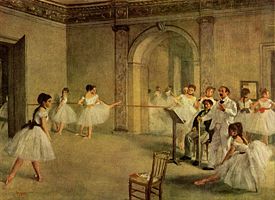
Ballet is a highly stylized dance grade that developed into a popular courtly entertainment during the Italian Renaissance, a serious dramatic fine art in seventeenth century France, and a globe-renowned fine art in twentieth century Russia and America. Ballet is best known for its sophisticated techniques, such as pointe work, turn-out of the legs, and loftier extensions; its graceful, flowing, precise movements; and its ethereal qualities.
Contents
- 1 The Origin of ballet
- 1.one Ballet in Italy—"Ballo"
- i.two France—courtroom trip the light fantastic
- 1.iii Russian and Danish ballet
- 2 The fine art of ballet
- ii.ane Neoclassical ballet
- ii.2 Contemporary ballet
- iii Technique
- iv International entreatment
- 5 Notes
- 6 References
- 7 External links
- 8 Credits
In Aristotle's "Poetics," dance was likened to drama and held "to represent men's characters equally well equally what they do and endure."[1] In ballet, the expressive, disciplined motion of the human body through carefully choreographed productions enables dancers to advance a dramatic narrative, typically a folk tale, while conveying a range of man emotions. Joys, sorrows, hopes, and ethics are dramatized without words, enabling this art form to speak universally across boundaries of language and civilisation.
The Origin of ballet
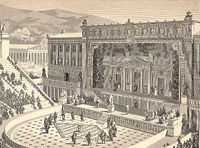
Theatre in ancient Hellenic republic.
Dance is prominent throughout history. Traditions of narrative dance evolved in People's republic of china, Republic of india, Indonesia, and Ancient Hellenic republic. Theatrical trip the light fantastic was well-established in the wider loonshit of ancient Greek theater. When the Romans conquered Hellenic republic, they assimilated Greek dance and theater with their fine art and civilization.[ii] While dance continued to exist of import throughout the Middle Ages, in spite of occasional suppression by the Church, ballet equally a recognizable dance form did not emerge until the late 1400s, in Italy. While Italy may be credited with the inception of the ballet tradition, the French enabled it to blossom. Incorporating aspects of Italian ballet, French ballet gained prominence and influenced the trip the light fantastic toe genre internationally. To this day, the majority of ballet vocabulary originates from French.
The discussion ballet itself comes from French, and was incorporated into English during the seventeenth century. The French word in turn has its origins in Italian balletto, a diminutive of ballo (dance). Ballet ultimately traces back to Latin ballere, meaning to trip the light fantastic.[3]
Ballet in Italian republic—"Ballo"
Ballet originated in the Renaissance court as an outgrowth of court pageantry in Italy,[4] Aloof weddings were lavish celebrations. Court musicians and dancers collaborated to provide elaborate amusement for them.[5] Ballet was further shaped by the French ballet de cour, which consisted of social dances performed by the nobility in tandem with music, spoken language, poesy, song, decor, and costume.[6] When Catherine de' Medici, an Italian blueblood with an interest in the arts, married the French crown's heir, Henry II of France, she brought her enthusiasm for dance to France and provided fiscal support.
A ballet of the Renaissance would await nothing like a modern operation of Giselle or Tchaikovsky's Swan Lake at Moscow's Bolshoi Theater. Tutus, ballet slippers, and pointe work was as withal unheard of in ballet. The choreography was adapted from courtroom trip the light fantastic toe steps. Performers dressed in the fashions of the times; for women that meant formal gowns that covered their legs to the ankle.[seven] Early on ballet was participatory, with the audience joining the trip the light fantastic towards the terminate.
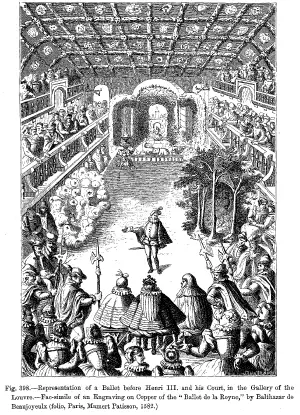
Engraving of the first scene of the Ballet Comique de la Reine. Click to enlarge.
Domenico da Piacenza was one of the first dancing masters. Along with his students, Antonio Cornazano and Guglielmo Ebreo, he was trained in dance and was responsible for teaching nobles the art. Da Piacenza left one work, De arte saltandi et choreus ducendi (On the Fine art of Dancing and Conducting Dances), which was compiled by his students.[viii]
An early ballet, if not the start, produced and shown was Balthasar de Beaujoyeulx'due south Ballet Comique de la Reine (1581) and was a ballet comique (ballet drama).[nine] In the same year, the publication of Fabritio Caroso'due south Il Ballarino, a technical manual on courtroom dancing, both performance and social, helped to establish Italy every bit a eye of technical ballet development.[10]
France—courtroom dance
Ballet developed equally a split up, performance-focused art form in France during the reign of Louis XIV, who was passionate about dance and determined to reverse a decline in trip the light fantastic toe standards that began in the seventeenth century. Louis XIV established the Académie Royale de la Danse (which evolved into the company known today every bit the Paris Opera Ballet) in 1661.[11] The primeval references to the 5 core positions of ballet appear in the writings of Pierre Beauchamp, a court dancer and was also a choreographer.[12]
Jean-Baptiste Lully, an Italian composer serving in the French court, played a meaning role in establishing the general direction in which ballet would follow for the next century. Supported and admired by Louis 14, Lully frequently cast the king in his ballets. The appellation Sunday King, by which the French monarch is even so normally referred, originated from Louis Xiv's office in Lully's Ballet de la Nuit (1653).[13] Lully'southward main contribution to ballet was his nuanced compositions. His agreement of movement and dance immune him to compose specifically for ballet, with musical phrasings which complemented physical movements.[14] Lully too went on to collaborate with the French playwright Jean-Baptiste Molière. Together, they adapted an Italian theater mode, the commedia dell'arte, into their work for a French audience, creating the comédie-ballet. Amongst their greatest productions was an adaptation of Molière'south Le Conservative Gentilhomme (1670).[15] Later in life, Lully became the starting time manager of the Académie Royale de Musique after its telescopic was expanded to include trip the light fantastic toe.[xvi] By synthesizing Italian and French trip the light fantastic toe styles, Jean-Baptiste Lully created a legacy that would define the hereafter of ballet.
Since the first formal ballet schoolhouse was established in French republic, trip the light fantastic toe terminology was crystallized there. Most everything in ballet is described by a French word or phrase. (One even bids dancers proficient luck in French.) Because of the universal terminology, dancers tin take a ballet class anywhere in the world and understand the director's instructions.[17]
Russian and Danish ballet
After 1850, involvement in ballet began to wane in Paris and grow in Denmark and, most notably, Russia, thanks to masters such as Baronial Bournonville, Jules Perrot, Arthur Saint-Léon, Enrico Cecchetti, and Marius Petipa. The Mariinsky Theater was built in St. Petersburg in 1860, and the Bolshoi Theater even earlier, in 1824. The Regal Ballet, known after the Bolshevik revolution as the Kirov Ballet (named subsequently the Leningrad political party dominate, Sergei Kirov), besides rose in world prominence.
In the late nineteenth century, colonialism brought new awareness of Asian and African cultures. Orientalism was in vogue, but seen from a colonial perspective, oriental culture was a source of mere fancy. The East was often perceived as a faraway identify where anything was possible, provided it was lavish, exotic, and decadent. Petipa appealed to pop taste with The Pharaoh's Girl (1862), and afterward The Talisman (1889), and La Bayadère (1877).
Petipa is best remembered for his collaborations with Tchaikovsky, choreographing The Nutcracker (1892, though this is open to some debate among historians), The Sleeping Beauty (1890), and the definitive revival of Swan Lake (1895, with Lev Ivanov), all drawn from western sociology.
The classical tutu, a short skirt supported past layers of crinoline that revealed the dancers' acrobatic legwork, began to appear at this time. Occasionally the tutu revealed more than than the audience cared to encounter and it became customary to vesture a leotard as an undergarment.[18]
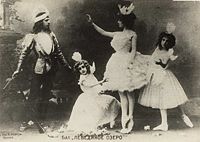
Mikhail Mordkin as Prince Siegfried and Adelaide Giuri as Odette with students as the petty swans in the Moscow Imperial Bolshoi Theatre'due south production of the Petipa/Ivanov/Tchaikovsky's Swan Lake. 1901
The choreographer Sergei Diaghilev brought ballet full-circumvolve dorsum to Paris in 1909, when he opened his Ballet Russe, residing first in the Théâtre Mogador and Théâtre du Châtelet, Paris; and and then in Monte Carlo. The company sprang from the Russian tsar'southward Majestic Ballet (as well known every bit the Mariinski Ballet, or the Kirov Ballet) of St. Petersburg, from which all its dancers were associated and trained, under the influence of the corking choreographer Marius Petipa. The Ballet Russe created a awareness in Western Europe because of the great vitality of Russian ballet compared with French trip the light fantastic at the time. It became the virtually influential company in the twentieth century, and that influence, in one form or another, has lasted to the nowadays twenty-four hour period. For example, Diaghilev and composer Igor Stravinsky combined their talents to bring Russian sociology to life in The Firebird and Petrushka. And Vaslav Nijinsky became famous for his leaps. The most controversial piece of work of the Ballet Russe was Stravinsky's Rite of Spring, which shocked audiences with its theme of human cede.
Later on the "aureate age" of Petipa, Russian ballet entered a period of stagnation, until choreographer Michel Fokine revitalized the art.[19] Fokine began his career in Saint petersburg just moved to the United States subsequently the Russian Revolution of 1917. Believing that the ballet of the fourth dimension offered little more than prettiness and athleticism, Fokine demanded drama, expression, and historical authenticity in addition to technical virtuosity. The choreographer, he believed, must research the period and cultural context of the setting and turn down the traditional tutu in favor of authentic period costuming. Accordingly, Fokine choreographed Sheherazade and Cleopatra and reworked Petrushka and The Firebird. One of his almost famous works was The Dying Swan, performed past prima ballerina Anna Pavlova. Beyond her talents as a ballerina, Pavlova had the theatrical gifts to fulfill Fokine'south vision of ballet every bit drama. Legend has it that Pavlova identified so much with the swan role that she requested her swan costume from her deathbed.
Russian companies, particularly afterward World War Two toured all over the world, revitalizing ballet in the west and elevating information technology as an art embraced by the general public. In America, choreographer George Balanchine modified the ballet techniques he had learned in his native Russia and brought state-of-the-art technique to America by opening a school in Chicago and later in New York and adapting ballet to new media, specifically motion-picture show and goggle box.[20] A prolific worker, Balanchine re-choreographed classics such as Swan Lake and The Sleeping Beauty as well as staging scores of new ballets. He produced original interpretations of the dramas of William Shakespeare such equally Romeo and Juliet, The Merry Wives of Windsor, and A Midsummer Nighttime's Dream. In Jewels, Balanchine broke with the narrative tradition in full length ballets and dramatized a theme rather than a plot. Today, partly thank you to Balanchine, ballet is i of the nigh renowned trip the light fantastic toe styles in the earth.
Barbara Karinska, a Russian emigrant and a skilled seamstress, collaborated with Balanchine to elevate the fine art of costume design from a secondary role to an integral part of a ballet functioning. She introduced the bias cut and a simplified classic tutu that allowed the dancer more liberty of motility. With meticulous attention to detail, she decorated her tutus with beadwork, embroidery, crochet, and appliqué.
Russian federation gave the world not only bang-up directors, choreographers, and set designers, but most of all, great dancers. In improver to Najinsky and Pavlova, Russian federation produced many of the twentieth century'due south great ballet performers, including Rudolf Nureyev, Natalia Makarava, and Mikhail Baryshnikov, amid others.
The art of ballet
The eighteenth century saw major advances in the technical standards of ballet, and during this period it came to exist regarded as a serious dramatic fine art form on par with opera. Central to this development was the seminal piece of work of Jean-Georges Noverre. His Lettres sur la danse et les ballets (1760) focused on developing the ballet d'action, in which the movements of the dancers are designed to limited character and assist in the narrative. At this time, women played a secondary role as dancers, burdened as they were with hoops, corsets, wigs, and high heels.
Developments in ballet limerick were too advanced by composers such equally Christoph Gluck. Finally, ballet was divided into three formal techniques: Sérieux, demi-caractère, and comique. Ballet also began to exist featured in operas as interludes called divertissements.
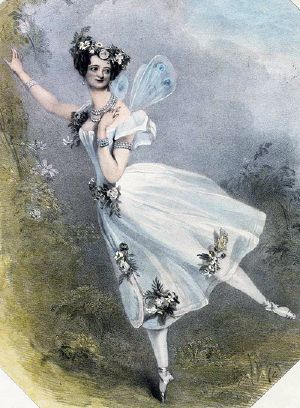
The nineteenth century was a menstruum of cracking social modify, reflected in ballet by a shift away from before aloof patronage and sensibilities. Ballerinas such as Marie Taglioni and Fanny Elssler pioneered new techniques, such as pointework, that elevated the ballerina into prominence as the ideal stage figure. At the same time, the ballet slipper was invented to support pointe work. Professional librettists began crafting the stories in ballets, and teachers like Carlo Blasis codification ballet technique in the bones form that is nonetheless used today.
The rise of Romanticism, a reaction in the arts against Enlightenment rationalism and growing industrialization, led choreographers to compose romantic ballets that were light and blusterous. These fanciful ballets portrayed women as frail, unearthly beings; delicate creatures who could be lifted effortlessly. Ballerinas began to vesture romantic tutus, with pastel, flowing skirts that bared the shins. The stories revolved around uncanny, folkloric spirits, such as in La Sylphide, one of the oldest romantic ballets still danced today. Starting from La Sylphide, ballerinas also began to trip the light fantastic on their toes, which further enhanced their image as ethereal, unearthly beings.
Neoclassical ballet
Neoclassical ballet describes a dance manner that uses traditional ballet vocabulary but is generally more expansive than the classical structure allowed. For example, dancers oftentimes dance at more extreme tempos and perform more technical feats. Spacing in neoclassical ballet is unremarkably more modern or complex than in classical ballet. Although arrangement in neoclassical ballet is more varied, the focus on structure is a defining characteristic of neoclassical ballet.
The neoclassical way of twentieth century ballet was best exemplified by the works of George Balanchine. It drew on the avant-garde technique of nineteenth century Russian regal dance, only stripped it of its detailed narrative and dense theatrical setting. What was left was the dance itself, sophisticated but sleekly modernistic, retaining the pointe shoe aesthetic, but eschewing the involved drama and mime of the full length story ballet.
Tim Scholl, author of From Petipa to Balanchine, considers Balanchine's Apollo (1928) to be the start neoclassical ballet, a return to grade in response to Serge Diaghilev'southward abstract ballets. Although much of Balanchine'due south piece of work epitomized the genre, British choreographers Frederick Ashton and Kenneth MacMillan were too neat neoclassical choreographers.
Gimmicky ballet
Contemporary ballet is a form of dance influenced by both classical ballet and modern dance. Information technology takes its technique and utilise of pointework from classical ballet, yet it permits a greater range of motility than the strict trunk lines set up along past schools of ballet technique. Many of its concepts come from the ideas and innovations of twentieth century modern trip the light fantastic toe, including floorwork and turn-in of the legs.
While mostly identified with neoclassical ballet, George Balanchine is oftentimes thought to have pioneered the techniques of contemporary ballet as well. He used flexed easily (and occasionally anxiety), turned-in legs, off-centered positions, and non-classical costumes (such as leotards and tunics instead of tutus) to distance himself from the classical and romantic ballet traditions. Balanchine as well brought modern dancers similar Paul Taylor into his company, the New York City Ballet, every bit in the 1959 Balanchine ballet, Episodes. Collaborating with mod dance choreographer Martha Graham, Balanchine expanded his exposure to modern techniques and ideas. Likewise during this flow, choreographers such as John Butler and Glen Tetley began to experiment with ballet and mod techniques.
One notable dancer who trained with Balanchine was the Russian emigrant Mikhail Baryshnikov. Post-obit his date as artistic director of the American Ballet Theatre in 1980, Baryshnikov worked with various modern choreographers, most notably Twyla Tharp. Tharp choreographed Push Comes To Shove for ABT and Baryshnikov in 1976; in 1986, she created In The Upper Room for her own company. Both were considered innovative for their use of distinctly mod movements melded with the use of pointe shoes and classically-trained dancers.
Tharp likewise worked with the Joffrey Ballet visitor, founded in 1957 by Robert Joffrey. She choreographed Deuce Coupe in 1973, using pop music and a blend of modern and classical ballet techniques. The Joffrey Ballet continued to perform numerous contemporary pieces, many choreographed by co-founder Gerald Arpino.
Today, there are many explicitly contemporary ballet companies and choreographers. These include Alonzo Rex and his company, Alonzo King'south LINES Ballet; Nacho Duato and Compañia Nacional de Danza; William Forsythe, who has worked extensively with the Frankfurt Ballet and today runs his own company; and Jiří Kilián, currently the artistic managing director of the Nederlands Dans Theatre. Traditionally "classical" companies, such as the Kirov Ballet and the Paris Opera Ballet, likewise regularly perform gimmicky works.
Technique
Ballet, particularly classical ballet, puts great accent on the method and execution of movement.[21] A distinctive feature of ballet is the outward rotation of the thighs from the hip. The foundation of the dance consists of five bones positions, all performed with the turnout.
Young dancers receive a rigorous education in their schoolhouse's method of dance, which begins at an early on historic period and ends with graduation from high schoolhouse. Students are required to learn the names, meanings, and precise technique of each movement. Accent is put on building forcefulness generally in the lower trunk, specially the legs, and the core (also called the center, or the abdominals) every bit a strong core is necessary for many movements in ballet, especially turns, and on developing flexibility and potent anxiety for dancing en pointe.
Ballet techniques are generally grouped by the area in which they originated, such as the high extensions and dynamic turns of Russian ballet. Italian ballet, in contrast, tends to be more grounded, with a heavy focus on fast intricate footwork (eg. the Tarantella is a well known Italian folk dance, which is believed to have influenced Italian ballet). In many cases, ballet methods are named subsequently their originator. In Russia, two of the nearly notable systems are the Vaganova method, after Agrippina Vaganova, and the Legat Method, later Nikolai Legat; while in Italia, the technique is predominantly the Cecchetti method, later on Enrico Cecchetti. Another popular European system from around the same period is the Bournonville method, which originated in Denmark and is named after August Bournonville.
To perform the more than demanding routines, a ballet dancer must appear to defy gravity while working inside its constraints. Basic physics and the science of human perception provide insight into how this is accomplished. For example, during the grand jeté, the dancer may appear to hover. Physically, his/her middle of mass describes a parabola, as does a brawl when thrown. When leaping, however, the dancer extends the arms and legs and camouflages the fall, leading the audience to perceive that the dancer is floating. A Pas de Conversation (step of the cat) creates a similar illusion. The dancer starts from a plié, then during the ascending stage of the step, quickly lifts each human knee in succession with hips turned out, and so that for a moment both feet are in the air at the same time, passing each other. For a moment, the dancer appears suspended in air.
The ability of a dancer to seemingly agree a position in mid-air is called ballon. The fall must be performed carefully. The laws of physics prescript that momentum must exist prodigal, just a crash landing would destroy the impression of airiness and likely injure the dancer. Part of the solution is a flooring designed to absorb shock. The dancer likewise bends at the knees (plies) and rolls the foot from toe to heel. For creative likewise every bit safety reasons, this technique must be taught by a qualified instructor.
International appeal
Ballet has spread throughout the globe, notably in the stagings of the Imperial Danish Ballet, the Sadler'south Regal Ballet of London, American Ballet Theatre, the Australian Ballet, and more recently the China Central Ballet, Hong Kong Ballet, and the Ballet Company of the New National Theater of Tokyo, as well equally the National Ballet University and Trust set up in India. The Korean National Ballet (founded in 1962), and more recently Universal Ballet of Seoul, have contributed to the popularization of ballet in Korea. The Universal Ballet invited Oleg Vinogradov, the artistic director of the Kirov Ballet for 22 years, to phase classics from the Kirov repertory starting in 1992, and as artistic director in 1998, thus introducing the Russian ballet fashion in Korea.
The athleticism and virtuosity of mod ballet has won international recognition. Re-stagings of beloved ballets, as well equally innovative modern dance, testify to the flexibility and vitality of the art. Dancers and choreographers constantly seek to explore new technical and dramatic frontiers, and international tours of trip the light fantastic toe companies and aristocracy schools of dance confirm the continuing global entreatment of gimmicky ballet.
Notes
- ↑ Aristotle (1920), p. xi
- ↑ Lee (2002), pp. ii-3.
- ↑ Chantrell (2002), p. 42.
- ↑ Kirstein (1952), p. 4.
- ↑ Andros on Ballet, Catherine de' Medici. Retrieved October 18, 2007.
- ↑ Bland (1976), p. 43.
- ↑ Robert Greskovic, BALLET 101: A Consummate Guide to Learning and Loving the Ballet. Retrieved October 18, 2007.
- ↑ Lee (2002), p. 29.
- ↑ Anderson (1992), p. 32.
- ↑ Lee (2002), p. 54.
- ↑ Banal (1976), p. 49.
- ↑ Mike McGee, The History of Trip the light fantastic toe. Retrieved Oct 18, 2007.
- ↑ Lee (2002), pp. 72-73.
- ↑ Lee (2002), p. 73.
- ↑ Lee (2002), p. 74. Anderson (1992), p. 42.
- ↑ Lee (2002), p. 74.
- ↑ Tom's Dance Folio, General Questions well-nigh Ballet and Modernistic Trip the light fantastic. Retrieved October 20, 2007.
- ↑ RingSurf, Ii Types Of Tutu. Retrieved October twenty, 2007.
- ↑ Yonkers Historical Society, Michel Fokine, Male parent of Modern Dance. Retrieved October 20, 2007.
- ↑ The Balanchine Foundation, George Balanchine. Retrieved October twenty, 2007.
- ↑ Kirstein (1952), pp. 6-seven, 21.
References
ISBN links support NWE through referral fees
- Aristotle. The Poetics, 2nd ed. Oxford: Oxford University Press, 1920.
- Anderson, Jack. Ballet & Modern Dance: A Curtailed History, 2nd ed. Princeton, New Jersey: Princeton Book Visitor, 1992. ISBN 0871271729
- Bland, Alexander. A History of Ballet and Trip the light fantastic in the Western World. New York: Praeger Publishers, 1976. ISBN 0275537404
- Chantrell, Glynnis, ed. The Oxford Essential Dictionary of Word Histories. New York: Berkley Books, 2002. ISBN 0425190986
- Kirstein, Lincoln and Muriel Stuart. The Classic Ballet. New York: Alfred A. Knopf, 1952.
- Lee, Carol. Ballet In Western Culture: A History of its Origins and Evolution. New York: Routledge, 2002.
- The Bournonville School: The DVD, The Trip the light fantastic Programme, The Music. Copenhagen: The Royal Danish Theatre, 2005.
External links
All links retrieved December 31, 2021.
- Physics of Dance
- English language National Ballet
- A Chat with Mikhail Fokine
Credits
New World Encyclopedia writers and editors rewrote and completed the Wikipedia article in accordance with New World Encyclopedia standards. This article abides past terms of the Creative Commons CC-by-sa 3.0 License (CC-past-sa), which may be used and disseminated with proper attribution. Credit is due under the terms of this license that tin reference both the New World Encyclopedia contributors and the selfless volunteer contributors of the Wikimedia Foundation. To cite this article click here for a list of acceptable citing formats.The history of earlier contributions by wikipedians is accessible to researchers here:
- Ballet history
- Ballets_Russes history
- Neoclassical_ballet history
- Contemporary_ballet history
The history of this article since it was imported to New World Encyclopedia:
- History of "Ballet"
Note: Some restrictions may employ to use of individual images which are separately licensed.
johnsonalonds1965.blogspot.com
Source: https://www.newworldencyclopedia.org/entry/Ballet
0 Response to "In the Film the St Petersburg Ballet Director Compares Ballet to What Art Form"
Post a Comment